Fermentation Pressure Control Valve Explained: A UK Buyer's Guide
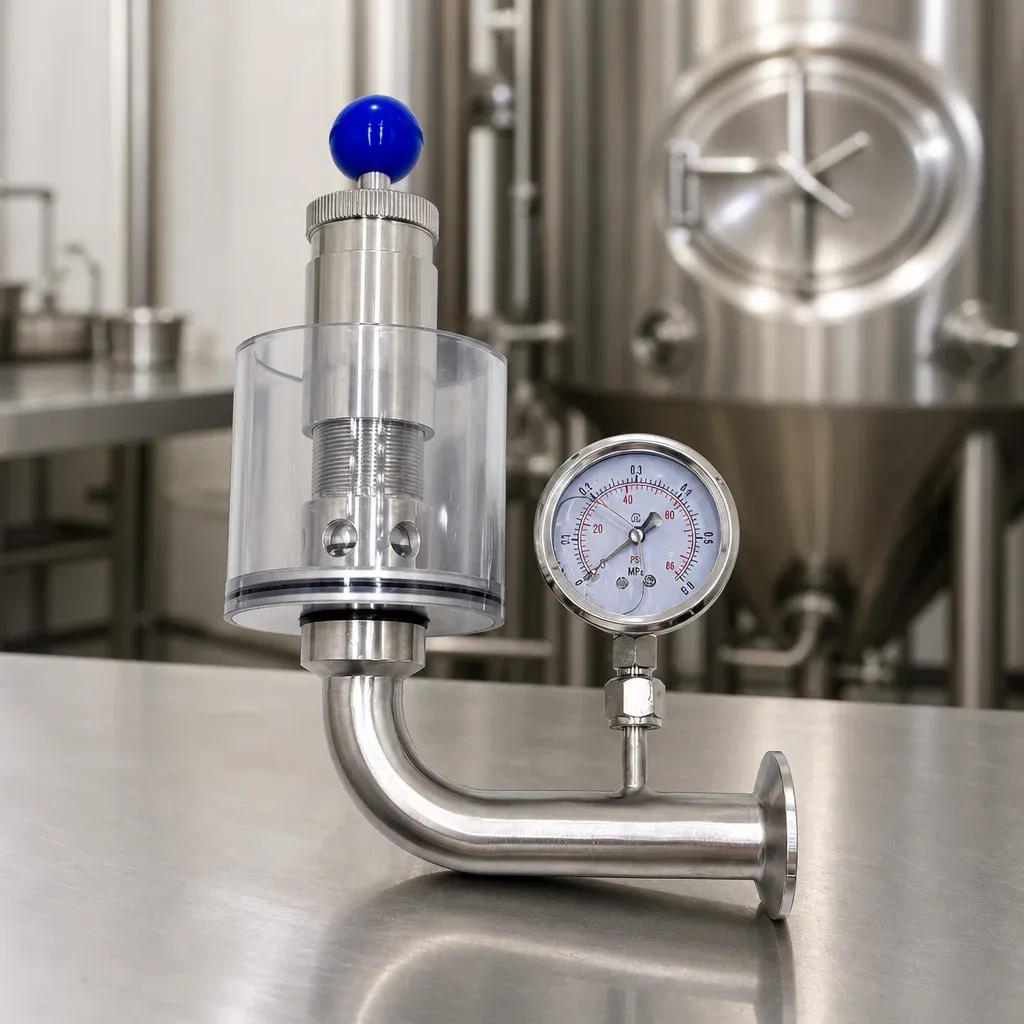
A fermentation pressure control valve is a valve fitted to a sealed fermenter that holds pressure at a chosen level by venting excess CO2 once the set point is reached. In practice, UK brewers and drinks producers use it to control pressure during fermentation, support safer closed transfers, improve consistency and retain natural carbonation.
TL;DR: A fermentation pressure control valve helps you manage CO2 presn a closed vessel, which can improve batch consistency, reduce oxygen exposure during transfers and support natural carbonation. For UK brewers, a sanitary Tri Clamp spunding valve is usually the most practical option because it is easier to clean, easier to inspect and better suited to hygienic process work.
For UK home brewers, pilot breweries and commercial producers working with sanitary fittings, the appeal is straightforward. An adjustable pressure relief valve tri clamp spunding valve brings precise sanitary pressure control for fermentation, transfer and carbonation, without relying on improvised assemblies that are harder to clean and harder to trust.
Key Takeaways
- A fermentation pressure control valve regulates vessel pressure during active fermentation, transfer and carbonation.
- Adjustable set pressure helps maintain repeatable results and supports cleaner process control.
- Tri Clamp sanitary connections are well suited to UK breweries and serious home setups because they are robust, easy to strip down and straightforward to clean.
- Pressure control can reduce foaming, support closed transfers and help retain dissolved CO2.
- Buying decisions should focus on pressure range, sanitary build quality, gauge readability, compatibility and ease of maintenance.
- For safety, valves must be used within the pressure rating of the vessel and the wider system.
What is a fermentation pressure control valve?
A fermentation pressure control valve is a device fitted to a sealed fermenter or process vessel to hold pressure at a chosen level by venting excess gas once that press reached. In brewing and other carbonated beverage applications, it is commonly used as a spunding valve arrangement to manage CO2 produced during fermentation.
Instead of allowing pressure to rise unchecked, the valve opens at the set point and releases gas in a controlled way. As a result, the operator gets a more stable process and better control over product quality. In practical terms, it can be used to:
- Control pressure during active fermentation
- Assist with pressure transfer between vessels
- Support natural carbonation by retaining part of the produced CO2
- Reduce excessive foaming and CO2 breakout during handling
- Provide a cleaner, more repeatable alternative to loosely assembled blow-off arrangements
For systems built around hygienic stainless hardware, a Tri Clamp configuration is especially attractive. It fits neatly into sanitary process lines and can be removed for cleaning, inspection and reassembly without specialist tools.
Why is pressure control important during fermentation?
Fermentation is never just about temperature and yeast pitch rate. Pressure also influences CO2 retention, foam behaviour and how predictable the process feels from one batch to the next. Therefore, a proper fermentation pressure control valve gives you a reliable way to manage pressure rather than reacting after problems appear.
How does it improve batch consistency?
One of the biggest advantages of controlled press repeatability. Whether you are producing a house lager in a commercial setting or fine-tuning a small-batch pale ale at home, having a known pressure set point makes process outcomes easier to replicate. That matters commercially because inconsistency is expensive.
According to UK food and drink sector reporting, consistency and process control remain central to efficient production. In a sector operating at industrial scale, repeatability is not a theoretical benefit; it is an operational requirement.
How does it help with closed, low-oxygen transfers?
Pressure-managed systems also make closed transfers more practical. When moving product from a fermenter to a bright tank, conditioning vessel or keg, controlled pressure helps push liquid with less air exposure. Consequently, this is particularly valuable for products where freshness, shelf life and carbonation retention matter.
Can it reduce foaming and help retain carbonation?
Anyone who has handled an overactive ferment knows how quickly foam can become a mess and a loss point. Controlled venting can keep presn a workable range, making the process calmer and easier to monitor. In addition, it helps retain dissolved CO2 that would otherwise be lost through uncontrolled venting.
How does a fermentation pressure control valve work?
The principle is simple. Gas pressure builds inside the sealed vessel as fermentation produces CO2. The valve is adjusted to a chosen threshold. Once internal pressure exceeds that threshold, the valve opens and releases gas until pressure falls back into range.
Most quality assemblies used in sanitary beverage applications combine several useful elements:
- An adjustable relief mechanism for setting the target pressure
- A pressure gauge for visual monitoring
- Tri Clamp sanitary fittings for hygienic connection
- Stainless steel wetted components suitable for repeated cleaning
Why does adjustability matter?
A fixed relief valve has its place for vessel protection, but a fermentation pressure control valve used in process work must be adjustable if it is going to be genuinely useful. Fermentation schedules, vessel sizes and product styles vary. Therefore, a controllable set point gives the operator room to dial in a process rather than compromise around a fixed number.
Why does sanitary construction matter?
In beverage production, cleanability is non-negotiable. Crevices, mixed materials of uncertain suitability and awkward threaded assemblies can all create avoidable hygiene risks. Based on our testing of sanitary gas control assemblies in stainless process setups, smoother cleanable surfaces and fewer unnecessary joints make inspection and routine cleaning more dependable. A stainless Tri Clamp build fits the hygiene expectations of modern brewing and drinks production more closely than improvised hardware made from general-purpose parts.
Is a Tri Clamp spunding valve better than an improvised pressure control setup?
UK buyers often compare a purpose-built sanitary assembly with lower-cost alternatives pieced together from regulators, hose fittings or non-sanitary valves. At first glance, improvised setups can look attractive on price. However, in day-to-day use, the trade-off is usually obvious.
What are the advantages of a purpose-built sanitary assembly?
- Designed for hygienic process environments
- Simpler to remove, inspect and clean
- More confidence in sealing and repeatability
- Better suited to stainless fermenters, brights and transfer manifolds
- Professional appearance for serious brewing spaces
What are the drawbacks of improvised assemblies?
- Can be harder to sanitise thoroughly
- Often rely on multiple adaptors and thread interfaces
- May be less stable or less precise in routine use
- Can create uncertainty over material compatibility and maintenance
GasPressur’s view is straightforward: precise sanitary pressure control for fermentation, transfer and carbonation is easier to achieve with a purpose-built assembly than with a collection of parts that were never designed to work as a hygienic unit.
What should UK buyers look for in a fermentation pressure control valve?
Choosing the right valve is partly about specification and partly about how you actually run your process. Before buying, it is worth checking the following points carefully.
Pressure range and adjustability
First, make sure the adjustment range suits your fermentation and transfer requirements. A valve that cannot hold the pressures you actually use will quickly become a compromise.
Gauge readability
Secondly, the gauge should be easy to read in a real working environment, including damp brewery conditions and low-angle installation points.
Connection compatibility
Check that the clamp size, seals and mating fittings match your fermenter or process line. In the UK, sanitary compatibility matters because mixed standards create avoidable downtime and cleaning issues.
Materials and cleanability
Look for stainless steel construction and a design that can be stripped, inspected and sanitised without difficulty. According to UK hygiene expectations for food and drink processing, equipment should be cleanable and suitable for its intended contact environment.
Maintenance and spare parts
Finally, consider whether routine maintenance is realistic. A valve is more useful long term when seals, gauges and wearing parts can be replaced without replacing the whole assembly.
Is a fermentation pressure control valve safe to use?
Yes, provided it is used correctly and within the limits of the vessel and the wider system. A pressure control valve is a process tool, not a substitute for proper vessel specification or over-pressure protection.
According to UK safety principles for pressurised systems, equipment should always be operated within its rated pressure limits and maintained in a condition suitable for service. Therefore, before use, confirm the pressure rating of the fermenter, fittings, clamps, seals and any connected receiving vessel.
- Never exceed the pressure rating of the vessel
- Confirm compatibility across the whole system, not just the valve
- Inspect gauges, seals and clamps routinely
- Clean and reassemble the valve correctly after use
- Use manufacturer guidance for setup and maintenance
Based on our testing, the most common problems come from poor assembly, mismatched fittings and assumptions about vessel pressure tolerance rather than from the valve design itself.
When should you use a fermentation pressure control valve?
A fermentation pressure control valve is useful whenever you want repeatable pressure management in a closed process. For example, it is commonly used during active fermentation, pressure transfer, conditioning and natural carbonation.
For UK brewers working with sanitary stainless equipment, it is especially relevant when process cleanliness, carbonation retention and low-oxygen handling are priorities. As a result, it suits both serious home setups and commercial production environments.
Final answer: do you need a fermentation pressure control valve?
If you are fermenting in a sealed vessel and want reliable control over pressure, then yes, a fermentation pressure control valve is one of the most useful additions you can make. It gives you a repeatable way to manage CO2, supports cleaner transfers and helps protect product quality.
For most UK buyers, the strongest choice is a sanitary, adjustable Tri Clamp assembly that is easy to clean, easy to monitor and compatible with the rest of the process line. In short, the right valve is not just a convenience; it is a practical control point for safer, more consistent fermentation.
Ready to try GasPressur?
Shop Now — £129.99